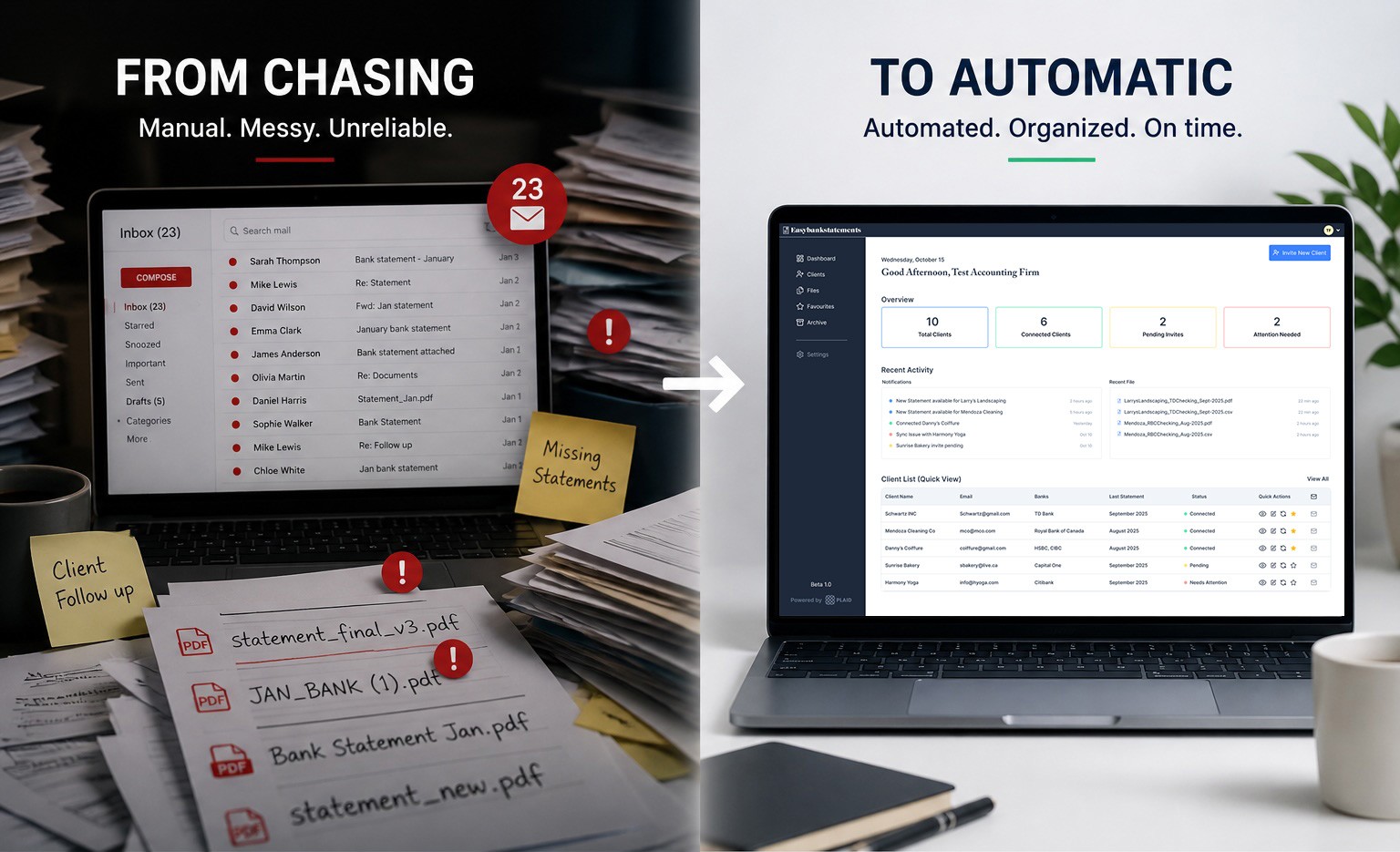
Many firms still use shared client banking credentials to retrieve statements. Here’s why that creates security, compliance, and workflow risk.
• 4 min read
• EasyBankStatements

In many bookkeeping firms, there is still a widespread but increasingly discouraged practice: using the client’s online banking credentials to log in and retrieve statements. Sometimes this means the client shares their actual username and password.In other cases, the firm uses a dedicated login created by the client. While this may seem efficient, it creates risks that many firms underestimate.
Why firms still do it
The reason is simple. It feels fast. Instead of chasing statements every month, the firm can log in directly and retrieve what they need. For smaller teams, this often becomes an informal operational shortcut. At low volume, it may even feel manageable. But as firms scale, this workflow introduces significant security and process concerns.
The biggest risk: shared credentials
Sharing actual client credentials is widely considered poor security practice. It creates immediate issues around accountability, password storage, and unauthorized access. Security and accounting guidance consistently recommend least-privilege, read-only access instead of shared logins.
If multiple team members use the same login, it becomes difficult to know:
who accessed the account
when statements were retrieved
whether security settings were changed
whether any sensitive information was exposed
This can also create liability concerns if access persists after an engagement ends.
A better alternative: delegated read-only access
The safer best practice is delegated, read-only access whenever the institution supports it. This gives the bookkeeping team access to statements and transaction history without exposing full credentials or enabling money movement. This aligns with the principle of least privilege: give access only to what the workflow requires.
The workflow issue
Beyond security, shared logins also create operational friction.
Passwords expire.
Two-factor authentication interrupts access.
Clients change devices or phone numbers.
Credentials get updated without notice.
This can quickly turn into another admin bottleneck.
Why modern firms are moving away from this
As firms grow, access control and client trust become more important. Modern workflows are moving toward secure, centralized, permission-based document collection rather than shared credentials. This reduces risk while keeping the statement retrieval process efficient.
Book a demo to see how EasyBankStatements helps firms move beyond shared login workflows and collect statements securely.