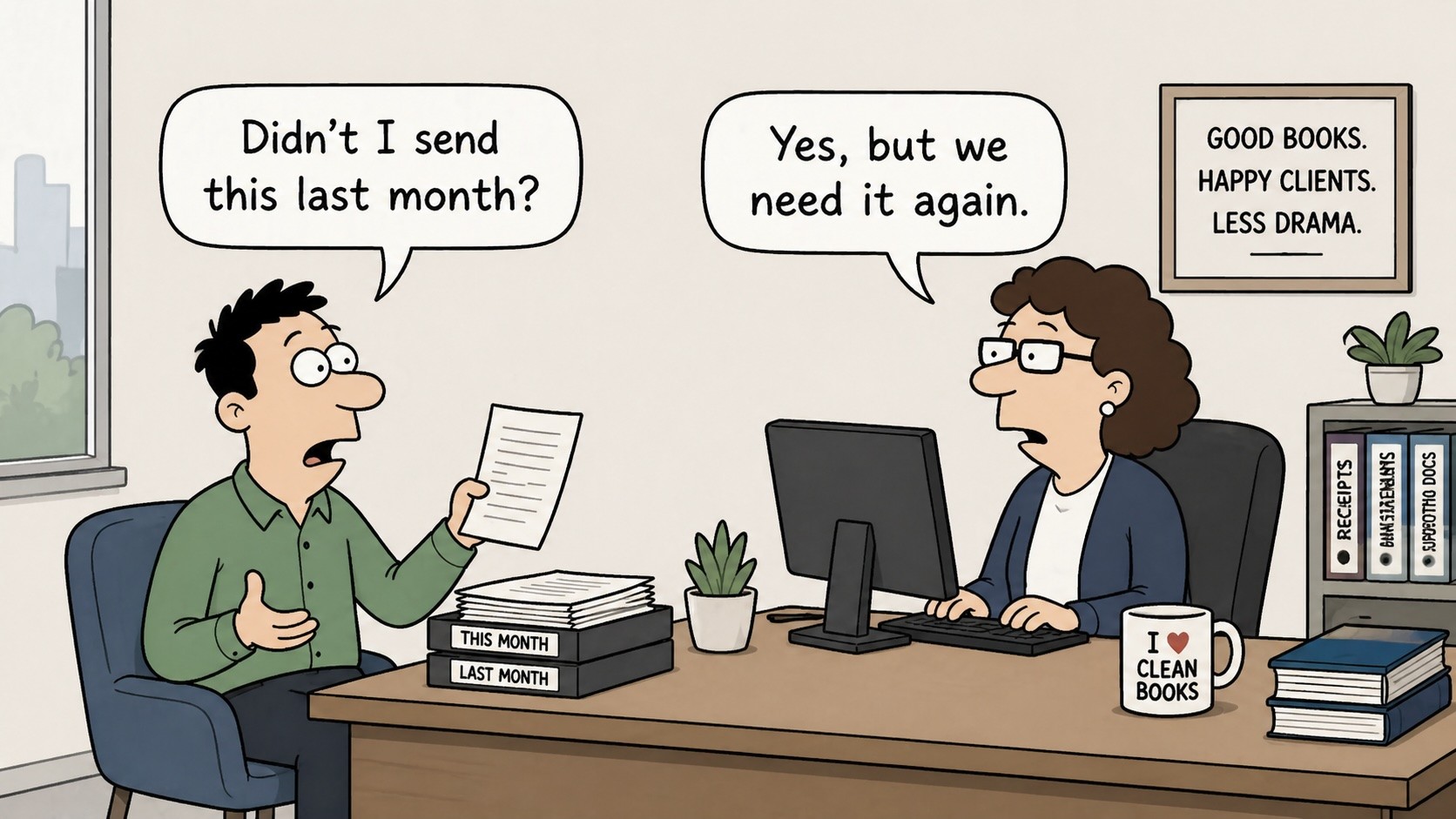
Manual bank statement collection breaks down faster than most firms realize. Here’s why automation is becoming the only viable path forward.
• 6 min read
• EasyBankStatements
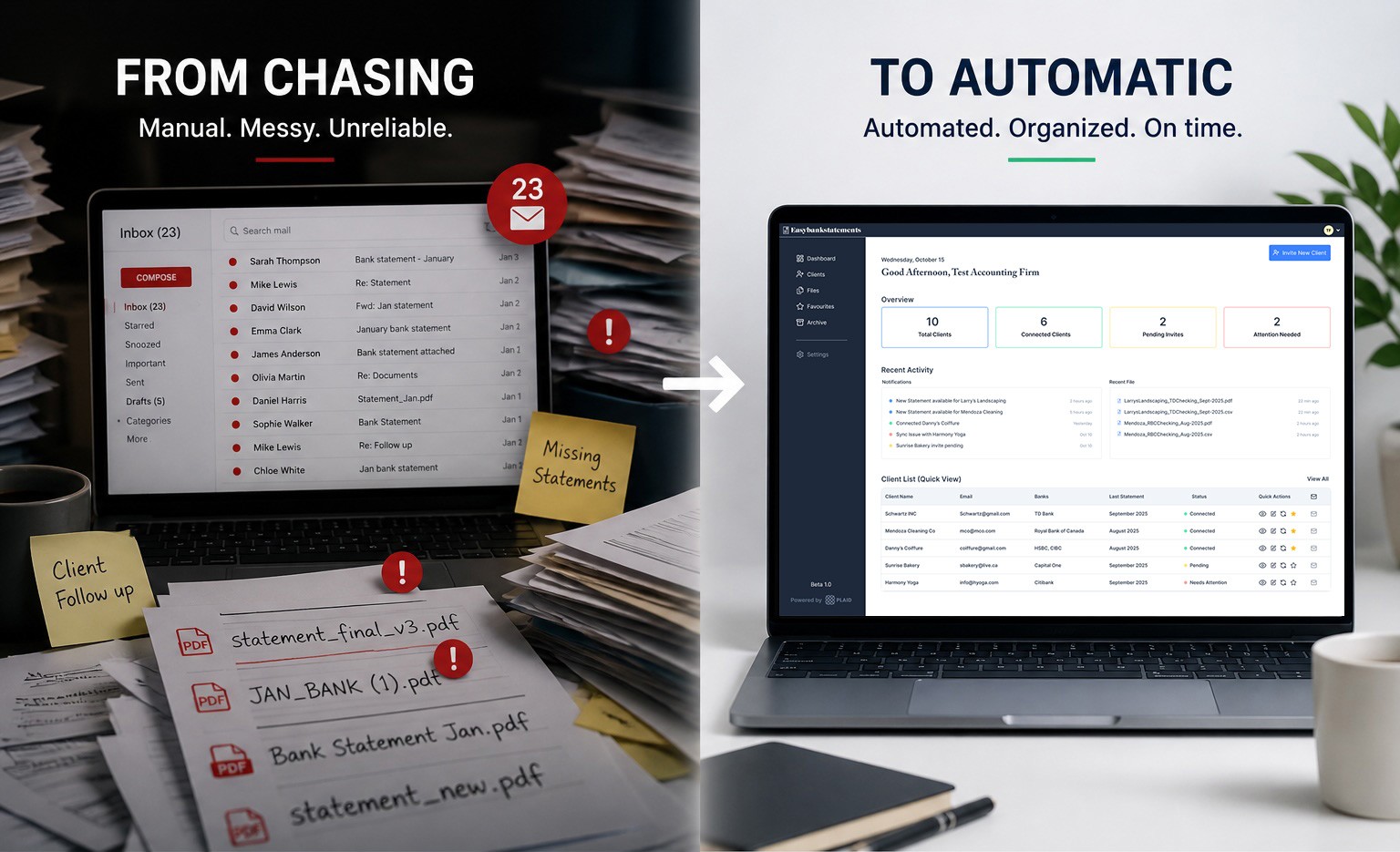
Bookkeeping firms can automate bank statement collection by connecting client accounts once, allowing statements to be retrieved and generated automatically each month without manual follow-up. On the surface, this sounds like a small operational improvement, but in practice, it changes how the entire month-end process behaves. The difference is not just speed. It is predictability. Most firms underestimate how much of their workflow is shaped by waiting, chasing, and reacting to client delays, and that hidden cost compounds every single cycle.
The problem no one wants to admit
Collecting bank statements from clients is widely accepted as part of the job, but that acceptance hides how inefficient the process actually is. Each month follows the same pattern of outreach, reminders, missed emails, and delayed responses. Even when a firm has a well-defined system with templates, portals, or scheduled emails, the outcome still depends on the client doing something at the right time. That dependency is the real issue. It introduces variability into a process that should be repeatable, and that variability forces firms to constantly adjust their timelines and expectations.
What makes this worse is that the cost is not always visible. It shows up as small delays that accumulate, pushing work further into the month and compressing timelines for review and delivery. Teams compensate by working around gaps instead of fixing the source of the problem. Over time, this becomes normalized, even though it is fundamentally inefficient. The process works, but only in the sense that it eventually produces the required documents, not in the sense that it operates cleanly or predictably.
Why traditional systems don’t actually solve it
Most firms attempt to improve this process by adding structure rather than removing the dependency. They introduce client portals, shared folders, or standardized email workflows, believing that better organization will lead to better outcomes. In reality, these systems only make the process look more controlled without changing the underlying behavior. The client is still responsible for uploading or sending documents, and the firm is still responsible for ensuring that it happens.
This approach works when clients are highly responsive, but it breaks down quickly at scale. As the number of clients increases, so does the number of follow-ups required to keep everything on track. The system becomes heavier rather than lighter, and the team spends more time managing the process instead of executing the work. The core issue remains untouched, because the workflow still depends on repeated client action rather than a one-time setup.
The shift to automated retrieval
Automated bank statement retrieval changes the structure of the workflow by removing the need for ongoing client participation. Instead of asking clients to send documents each month, firms can invite them once to securely connect their bank accounts. From that point forward, statements can be generated automatically based on the underlying transaction data. This is not just a convenience feature. It fundamentally alters the relationship between the firm and the client in the context of document collection.
Once the connection is established, the process becomes system-driven rather than client-driven. Historical data can be accessed immediately, often covering up to twenty-four months, and future statements are generated on a predictable schedule. The firm no longer needs to coordinate timing with the client or rely on reminders to maintain workflow continuity. The result is a process that behaves the same way every month, regardless of how responsive the client happens to be.
What this looks like in practice
In practice, the shift is less dramatic than most firms expect. There is no need for a full rollout or a complex migration plan. Most firms start by testing the approach with a single client to understand how it fits into their existing workflow. The client completes a one-time connection, and the firm immediately gains access to historical statements. From there, the monthly cycle continues automatically, with statements appearing without additional input.
What becomes apparent very quickly is not just the time saved, but the reduction in friction. There are fewer follow-ups, fewer gaps, and fewer points where the process can stall. Teams can begin their work earlier in the cycle because the required documents are already available. Over time, this leads to a more consistent cadence, where month-end is no longer defined by when documents arrive, but by when the firm chooses to begin.
Why this is becoming non-negotiable
As firms grow, the cost of manual collection increases disproportionately. What works with a small client base becomes increasingly difficult to manage as volume increases. More clients mean more variability, more follow-ups, and more opportunities for delays. At a certain point, the process stops scaling entirely, and the firm is forced to either add more administrative effort or accept ongoing inefficiencies.
Automation is not just a way to improve the process. It is a way to remove a structural limitation. By eliminating the need for repeated client action, firms can build workflows that scale without adding complexity. This is why automated bank statement retrieval is no longer a nice-to-have feature. It is becoming a baseline expectation for firms that want predictable operations and consistent delivery timelines.
Where this fits in your workflow
Most firms do not adopt this approach all at once. The transition typically begins with a single client, allowing the firm to evaluate how the system behaves in a real-world context. This incremental approach reduces risk while providing immediate insight into the impact on workflow efficiency. Once the benefits become clear, expanding to additional clients becomes a straightforward decision rather than a speculative one.
If collecting bank statements continues to slow down your month-end, it is worth looking at whether the issue is the process itself rather than how it is being managed. In many cases, the simplest way to understand the impact of automation is to test it in a controlled way and observe how the workflow changes. If you want to see how this would look in your own process, you can book a demo with EasyBankStatements and walk through it in a real scenario.